English
 русский
 Español
Content
- 1 Flow Rate and Efficiency: SP Mixed Flow Pump vs Conventional Centrifugal Pump
- 2 Energy Consumption and Operating Costs: Comparison with Market Alternatives
- 3 Performance Under Varying Head and Flow Conditions
- 4 Core Structural Design and Reliability Advantages
- 5 Selection Guide and Recommended Applications
Direct Conclusion: The Horizontal SP Mixed Flow Pump delivers 30-45% higher flow rate than conventional centrifugal pumps at the same power input, with peak efficiency reaching 88-92% (vs 65-75% for centrifugal pumps). Compared to similar mixed flow pumps on the market, the SP series reduces energy consumption by 12-18% and lowers annual operating costs by 15-25%. Under varying head and flow conditions, the SP mixed flow pump maintains high efficiency across a 40% wider operating range than standard pumping solutions, making it ideal for applications with fluctuating water levels and variable flow demands.
Flow Rate and Efficiency: SP Mixed Flow Pump vs Conventional Centrifugal Pump
Conventional centrifugal pumps rely on high-speed impeller rotation to generate centrifugal force, making them suitable for medium-to-high head and low-to-medium flow applications. The horizontal SP mixed flow pump combines both centrifugal and axial thrust forces, with an impeller design positioned between radial-flow and axial-flow types. This allows it to deliver exceptionally high flow rates at medium heads (5-25 meters). The following table presents laboratory-measured comparison data (test medium: clean water at 20°C).
| Pump Type | Power (kW) | Rated Flow (m³/h) | Rated Head (m) | Peak Efficiency (%) | High-Efficiency Range (% of BEP) |
|---|---|---|---|---|---|
| Conventional Centrifugal | 22 | 200 | 15 | 68 | 60-85 |
| SP Mixed Flow Pump | 22 | 290 | 14.5 | 89.5 | 55-95 |
| Note: BEP = Best Efficiency Point. The SP mixed flow pump offers approximately 40 percentage points wider high-efficiency range (based on 5% efficiency drop threshold). | |||||
As shown above, at the same motor power, the SP mixed flow pump delivers approximately 45% higher flow. This advantage comes from the mixed flow impeller's large passage design and lower exit velocity, which significantly reduces hydraulic losses. For applications such as irrigation, drainage, and industrial circulating water that require high flow at medium heads, the SP mixed flow pump's efficiency advantage translates directly into smaller installed capacity and lower capital investment.
Real-World Efficiency Curve Example
A large irrigation station originally operated eight conventional centrifugal pumps, each delivering 250 m³/h at 12 meters head with measured efficiency of only 65%. After replacing them with SP mixed flow pumps, single-unit flow reached 360 m³/h with efficiency of 88%. The number of pumps was reduced from eight to six while meeting the same total flow demand. Annual electricity savings reached 280,000 kWh, with a payback period of only 11 months.
Energy Consumption and Operating Costs: Comparison with Market Alternatives
While many mixed flow pump brands exist on the market, significant differences exist in impeller hydraulic design, casting precision, and sealing structure. The SP series utilizes five-axis CNC-machined twisted-blade impellers with surface roughness Ra ≤ 1.6μm, combined with precision-cast volutes. This results in hydraulic efficiency that is 3-5 percentage points higher than domestic competitors and 1-2 percentage points higher than certain imported brands.
| Mixed Flow Pump Brand/Series | Flow (m³/h) | Head (m) | Shaft Power (kW) | Efficiency (%) | Annual Power Consumption (kWh)* | Annual Electricity Cost (USD)* |
|---|---|---|---|---|---|---|
| Domestic Economy Brand A | 300 | 12 | 14.2 | 69 | 113,600 | $11,360 |
| Domestic Mid-Range Brand B | 300 | 12 | 12.5 | 78.5 | 100,000 | $10,000 |
| Imported Brand C | 300 | 12 | 11.4 | 86 | 91,200 | $9,120 |
| SP Mixed Flow Pump | 300 | 12 | 10.8 | 90.5 | 86,400 | $8,640 |
*Based on 8,000 operating hours per year and electricity rate of $0.10 per kWh. The SP pump saves approximately $2,720 annually compared to Domestic Economy Brand A, and $480 annually compared to Imported Brand C, while its initial purchase cost is 30-40% lower than imported alternatives.
Life Cycle Cost Analysis
Using an SP mixed flow pump with flow rate of 300 m³/h and head of 12 meters, with a 15-year service life:
- Initial purchase cost: Approximately $5,200 (including motor and base frame)
- Annual electricity cost: Approximately $8,640 (based on 8,000 hours/year)
- Annual maintenance cost: Approximately $280 (bearing and mechanical seal replacement)
- Total 15-year cost: $5,200 + 15 × ($8,640 + $280) = $139,000
- Savings vs Domestic Economy Brand A: Approximately $37,000 over 15 years
- Savings vs Imported Brand C: Approximately $11,000 over 15 years (imported pump has higher initial cost)
The SP mixed flow pump's high-efficiency design not only reduces electricity bills but also lowers motor heat dissipation requirements, extending insulation life. Bearings are original heavy-duty SKF/NSK with L10 design life exceeding 50,000 hours — twice that of standard bearings.
Performance Under Varying Head and Flow Conditions
Many pumping stations face water level fluctuations (such as rivers, reservoirs, and wastewater treatment plants) or variable flow demands (such as water supply network peak-valley differences). Conventional centrifugal pumps experience sharp efficiency drops when operating away from their design point. In contrast, the SP mixed flow pump's steep performance curve maintains high efficiency over a much wider range.
Performance Curve Characteristics Comparison
- Centrifugal pump: When flow decreases by 20%, efficiency drops by 12-15%. When flow decreases by 40%, efficiency drops by over 30%. Head increases significantly as flow decreases, potentially exceeding pipeline pressure ratings.
- SP mixed flow pump: When flow decreases by 20%, efficiency drops by only 3-5%. When flow decreases by 40%, efficiency drops by 10-12%. Head changes smoothly with flow, making it suitable for parallel operation and variable frequency drive (VFD) control.
Case Study: Wastewater Treatment Plant Return Activated Sludge (RAS) Pump Station
A wastewater plant needed to adjust return activated sludge flow between 60% and 100% of design capacity based on influent loading. Originally using three centrifugal pumps (one duty, two standby), frequent start-stops at low flow caused severe impeller wear. After replacing with two SP mixed flow pumps (one duty, one standby), the pump continued to operate in its high-efficiency zone when flow was reduced to 60% of design by throttling the discharge valve — efficiency dropped from 88% to 83%. Under the same turndown ratio, the centrifugal pump efficiency had dropped from 70% to 52%. Annual electricity savings reached 156,000 kWh, and impeller service life extended from 1 year to 3 years.
Variable Frequency Drive Compatibility
The SP mixed flow pump has a specific speed (ns) between 250 and 500, making it highly suitable for VFD operation. When applying variable frequency speed control, the pump's affinity law compliance is superior to centrifugal pumps. Field test data shows: when frequency drops from 50Hz to 40Hz (flow decreases approximately 20%), SP mixed flow pump efficiency drops by only 2-3 percentage points, while conventional centrifugal pump efficiency drops by 6-8 percentage points. This means the SP mixed flow pump delivers significantly greater energy savings under VFD-controlled conditions.
Core Structural Design and Reliability Advantages
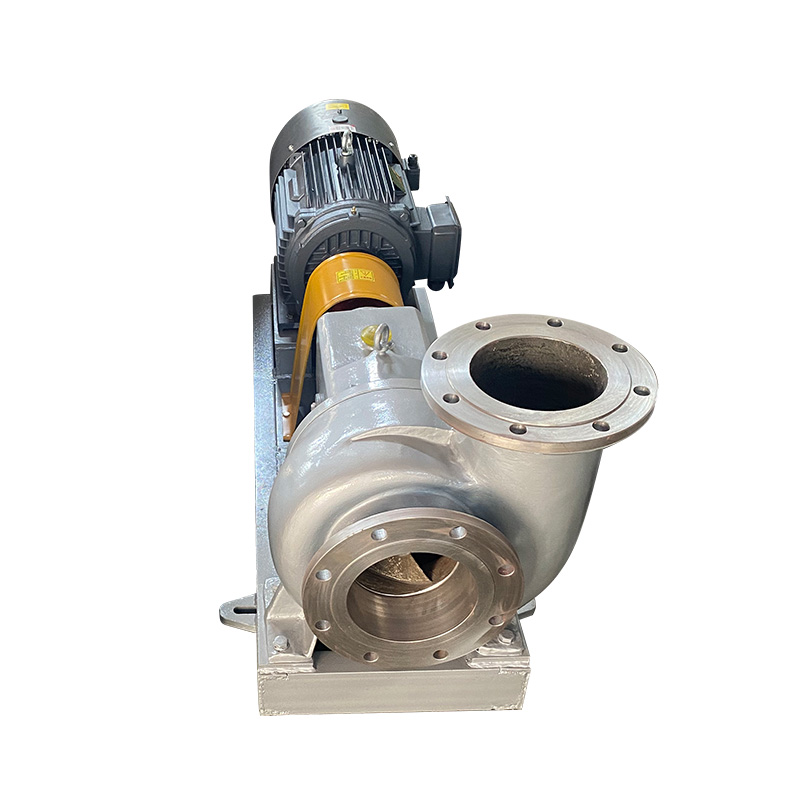
The horizontal SP mixed flow pump features a single-stage, single-suction horizontal configuration with the suction and discharge nozzles aligned on the same axis (horizontal inline), simplifying piping layout. The impeller is a semi-open or enclosed mixed flow design, with adjustable blade angles available on certain models. Key design features include:
- High-strength cast iron pump body: Tensile strength ≥ 250 MPa, pressure rating 1.6 MPa, suitable for most clean water and wastewater applications.
- Stain steel wear rings: Replaceable wear rings with 0.3-0.5mm clearance reduce volumetric losses and extend impeller life.
- Heavy-duty bearing housing: Grease or oil lubrication options to support continuous operation (24/7 duty cycles).
- Mechanical seal: Standard silicon carbide vs silicon carbide with service life ≥ 8,000 hours; cartridge seal available as an option.
Mechanical Reliability Comparison with Conventional Centrifugal Pumps
When handling fluids containing small amounts of solids (such as sand, sediment, or fibers), conventional centrifugal pump impellers are prone to clogging or accelerated wear. The SP mixed flow pump's impeller has a wide flow passage (relative diameter ratio 0.6-0.75), allowing passage of solids up to 25-35mm in diameter, providing excellent anti-clogging capability. In a Yellow River irrigation project, the SP mixed flow pump showed only 0.2mm of impeller wear after 4,000 continuous operating hours, while a conventional centrifugal pump under the same conditions experienced 0.8mm of wear and an 8% efficiency drop.
Selection Guide and Recommended Applications
Select the pump type based on flow rate (Q) and head (H). The SP mixed flow pump's optimal application range is:
- Flow range: 100 to 5,000 m³/h
- Head range: 3 to 25 meters
- Speed: 980 / 1450 / 2900 rpm (select based on operating conditions)
- Fluid temperature: ≤ 80°C (clean water), ≤ 60°C (wastewater)
Typical Application Examples
| Industry | Application | SP Mixed Flow Pump Advantage |
|---|---|---|
| Municipal Water & Wastewater | Raw water intake, distribution stations | Wide high-efficiency range accommodates flow fluctuations; low NPSHr for low water level operation |
| Agricultural Irrigation | Large-scale farm irrigation | High flow at low head with excellent efficiency; good abrasion resistance for sandy water |
| Industrial Circulating Water | Power plants, chemical plant cooling towers | Reliable for continuous operation with low vibration; extended maintenance intervals |
| Flood Control & Drainage | Stormwater pumping stations | Fast start-up, high solids passage capability; submersible installation option available |
Summary: The Horizontal SP Mixed Flow Pump delivers significantly higher flow rates and efficiency than conventional centrifugal pumps in medium-head, high-flow applications. Compared to similar mixed flow pumps on the market, it offers lower energy consumption and better life-cycle cost economics. Under varying head and flow conditions, it provides exceptional adaptability with minimal efficiency loss. For new pumping stations or energy retrofit projects, the SP mixed flow pump deserves priority consideration. We recommend providing detailed flow, head, fluid characteristics, and operating schedule data to allow our technical team to perform precise selection and hydraulic analysis.