English
 русский
 Español
Content
- 1 What a Double Suction Centrifugal Pump Is
- 2 Why the Split Case Double Suction Design Cancels Axial Thrust
- 3 Double Suction vs End Suction: Matching the Duty Point
- 4 Five Inputs That Decide the Double Suction Centrifugal Pump Model
- 5 Materials and Wear Parts That Decide Service Life
- 6 Suction Piping Rules That Protect the Double Suction Advantage
- 7 FAQ: Double Suction Centrifugal Pump Selection
A 1,450 m3/h circulating water duty at 48 m of head, with only 3.6 m of NPSH available at the suction flange, ends most single-suction selections before the quotation stage. The machine that survives that duty is normally a double suction centrifugal pump: one casing, one impeller, two suction eyes and a suction performance curve that a single-eye impeller cannot match at the same speed.
This guide is written for the people who sign off on that decision: plant engineers replacing a unit that keeps tripping on low suction pressure, project teams sizing a new circuit, and maintenance leads who inherit whatever was ordered. It covers what the design actually changes, where the break-even point against an end suction pump sits, which five inputs fix the model number, and the material and piping choices that decide whether the pump reaches its first planned overhaul.
What a Double Suction Centrifugal Pump Is
A double suction centrifugal pump is a centrifugal pump whose impeller takes liquid in from both sides of a single hub, splitting the total flow into two equal streams that merge again at the casing outlet.
Double suction centrifugal pump: a rotodynamic pump with one impeller, two opposing suction eyes fed by a common inlet branch, and a casing that collects the merged streams at the discharge nozzle. Hydraulically it behaves like two single-suction pumps in parallel sharing one shaft and one set of bearings.
That parallel comparison is the design logic, not a marketing line. Each eye handles half of the total flow, so inlet velocity at each eye is roughly half what an equivalent single-suction impeller would see at the same duty. Lower inlet velocity means a lower NPSH required, which is why thin suction margins stop being a problem once the impeller is doubled up.
The trade-offs are real and belong in the comparison before prices are opened. A double suction casing is larger and heavier, it carries two shaft seals instead of one, and the split joint has to be machined, gasketed and torqued correctly. For a 5 m3/h transfer duty none of that is justified; for a continuous 900 m3/h cooling water loop, the extra casing mass pays for itself in suction reliability alone.
Why the Split Case Double Suction Design Cancels Axial Thrust
Axial thrust in a double suction pump cancels itself, because the two impeller eyes sit back to back on the same shaft and the pressure acting on one shroud of the rotor is mirrored by the pressure acting on the other.
In a single-suction pump, full discharge pressure pushes against the back shroud of the impeller and produces a force that runs from several hundred to several thousand newtons depending on size and head. That force has to be managed with balance holes, a balance drum or a deliberately oversized thrust bearing, and each of those parts introduces its own wear pattern and failure mode. With opposed eyes, the residual axial load drops to a small percentage of the single-suction figure and the bearings carry radial load only, which is a major reason double suction rotors run smoothly for years in continuous service.
Symmetric inlet flow is not a piping detail. Feed one eye harder than the other and the rotor is loaded axially again, so suction geometry belongs inside the pump specification, not outside it.
Maintenance access is the second structural benefit. The classic double suction arrangement is the horizontally split, between-bearings casing, classified as BB1 under API 610. The top half lifts off, the rotor comes out, and the suction and discharge pipework stays bolted in place. In field service, a wear ring or bearing change that runs 8 to 12 hours on an end suction line is often finished in 3 to 5 hours on a split case unit, simply because nothing has to be cut free and re-aligned afterwards. Above roughly 40 bar, the same hydraulic design moves into a radially split between-bearings casing, BB2, which keeps the double suction impeller but wraps it in a pressure-containing barrel.
Double Suction vs End Suction: Matching the Duty Point
Above roughly 300 to 400 m3/h at the duty point, or whenever NPSH available drops below about 5 m, a double suction pump is normally the lower-risk choice. Below both thresholds, an end suction pump is usually cheaper to buy, easier to fit and just as reliable.
Double suction
- High flow from a single casing and a single driver
- Low NPSH required at high flow, so thin margins still work
- No thrust balancing device to wear or plug
- Split casing gives fast rotor access without pipe removal
- Two seals to flush, monitor and replace
- Larger footprint, heavier baseplate, higher purchase price
End suction
- Best value between about 5 and 300 m3/h
- Multistage versions extend head inside one casing
- Compact, single seal, simple alignment
- NPSH required climbs quickly as flow rises
- Axial thrust must be balanced internally
- Piping usually has to come off for rotor work
| Criterion | Double suction (BB1 or BB2) | End suction (OH1 or OH2) |
| Comfortable flow band | 300 to 3,000 m3/h per casing | 5 to 400 m3/h |
| Head per stage | 15 to 150 m | 20 to 120 m, higher when multistage |
| NPSH required at 1,200 m3/h | Typically 4 to 6 m | Typically 6 to 9 m |
| Axial thrust handling | Cancelled by opposed impeller eyes | Balance holes or balance drum |
| Casing joint | Horizontal for BB1, radial for BB2 | Radial |
| Shaft seals | Two | One |
| Rotor access | Casing top off, piping stays connected | Piping normally disconnected |
| Best fit | High flow, thin suction margin, continuous duty | General transfer, low flow loops, dosing |
When head climbs beyond what one double suction stage can deliver at two-pole speed, the flow is normally kept and the head is added per stage instead. A process pump such as the ZA line fills that gap without changing the suction arrangement.
 ZA Petrochemical Process Pump for API 610 ApplicationsAPI 610 process pump line for clean or slightly particle-laden, hot or cold, neutral or corrosive liquids; suits higher-head duties without changing suction arrangement.View Product →
At the far end of the scale, a duty such as 5,000 m3/h at 7 m is not a double suction question at all. That is axial flow territory, where a different hydraulic family does the same job with far less installed power.
 FJX Axial Flow Evaporator Circulating PumpLarge-capacity, low-head axial pump handling 300–12000 m3/h for evaporator forced circulation, crystallizers, and reactors in phosphate, salt, alumina, and caustic soda industries.View Product →
Five Inputs That Decide the Double Suction Centrifugal Pump Model
Five inputs fix the model number: duty flow and head, NPSH available, fluid properties, material of construction, and drive data. Everything else in the datasheet is a consequence of those five.
- Duty flow and head at the rated point, plus the maximum and minimum operating cases the plant will actually run.
- NPSH available calculated from the real system, compared against a tested NPSH required curve with a margin of at least 0.5 m at the rated point and 1.0 m at maximum flow.
- Fluid properties including specific gravity, viscosity, temperature, solids content and chloride level, because the fluid decides both the hydraulics and the metallurgy.
- Material of construction and corrosion allowance, which usually follow the chloride and solids data rather than the flow figure.
- Drive and installation data covering motor speed, voltage, coupling type, baseplate and rotation, all of which constrain the impeller trim that can be supplied.
Indicative NPSH required at 1,200 m3/h, shorter bar is better
Illustrative screening values for concept comparison only. Confirm every figure against a tested curve for the selected model and speed.
One rule keeps the selection honest: the duty point should sit between 80% and 110% of the flow at best efficiency point. Selecting well to the left of that band buys head nobody needs and pays for it with internal recirculation and radial load; selecting to the right invites cavitation, shaft deflection and short seal life.
For the surrounding decisions, including seal plans and casing style, the factory guide to petrochemical process pump selection walks through the adjacent steps in the same order.
Materials and Wear Parts That Decide Service Life
Most double suction pump failures in chemical service are material and clearance failures, not hydraulic ones. Impellers rarely lose their shape; wear rings open up, seals wear, and corrosion allowance disappears from the wrong place.
- 304 and 316L stainless: clean water, low chloride content, moderate temperature.
- Duplex 2205 and super duplex 2507: chloride-bearing water, seawater and higher strength at the split joint.
- CD4MCu: abrasive slurries where corrosion and wear overlap.
- Hastelloy grades and titanium: aggressive acids, chlorides and oxidising media where standard stainless fails early.
- 2520 heat-resistant alloy: hot media where thermal growth has to be accommodated in clearances.
Wear ring clearance is the most measurable item on any overhaul sheet. When a 200 mm wear ring clearance opens from 0.35 mm to 0.70 mm, expect a 3 to 6 per cent drop in head at the duty point, a matching efficiency loss, and a visible rise in bearing vibration. That is a maintenance decision, not a hydraulic one, and it is worth recording at every inspection.
A double suction pump with matched materials and maintained clearances routinely runs 8 to 12 years between major overhauls in clean water service. The same casing with an unmatched alloy in chlorinated water can fail inside two years.
Jiangsu Huanyu Chemical New Materials Co., Ltd., which builds the Huaning pump range from Jingjiang in Jiangsu province, produces an S/SH double suction line that carries these material options alongside its wider chemical pump catalogue.
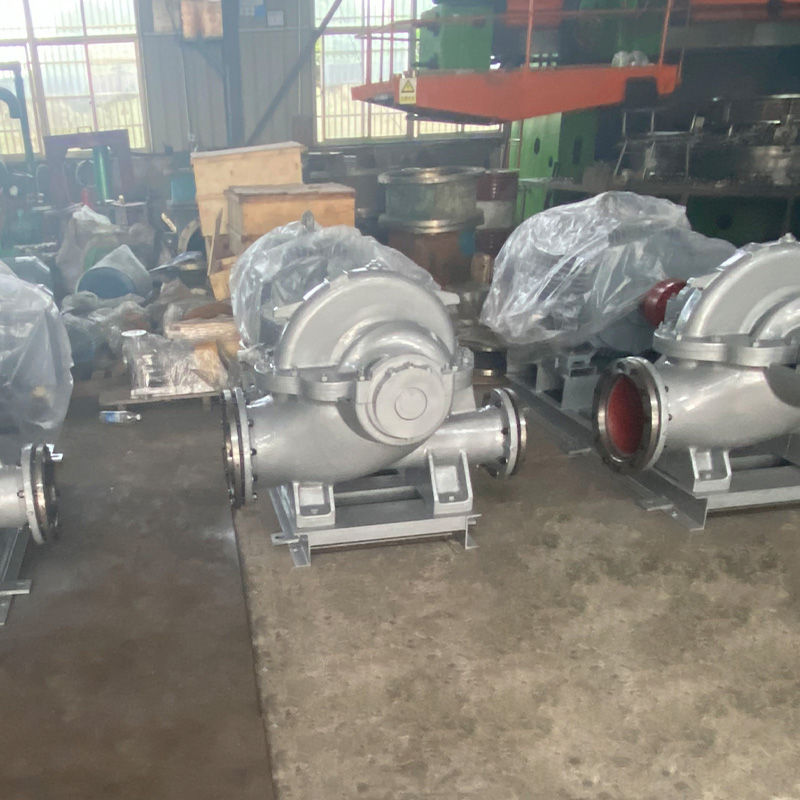 S SH Double Suction Pump for Petrochemical Process DutyDouble suction pump listed under petrochemical process pumps; suction piping layout determines whether its hydraulic advantage survives commissioning.View Product →
Suction Piping Rules That Protect the Double Suction Advantage
The suction piping arrangement decides whether the double suction advantage survives commissioning.
- Keep a straight run of five to ten pipe diameters upstream of the suction flange so the flow arrives evenly.
- Never bolt a short-radius elbow directly onto the flange; the two eyes will receive unequal flow and the rotor will be loaded axially.
- Use a symmetric twin-inlet arrangement wherever both eyes must be fed from one header, and check the branch lengths match.
- Support suction and discharge piping independently so no pipe strain reaches the casing when the joint is torqued.
- Recheck coupling alignment after the piping is connected, both cold and at operating temperature.
- Hold bearing vibration below 2.8 mm/s rms at the rated point, the zone A to B boundary for new machines under ISO 10816-3.
Ask for the predicted duty point on a tested curve rather than a generic catalogue plot, and insist the guaranteed NPSH required figure carries a tolerance. Send the actual duty, fluid data and system NPSH to the factory for a selection check before the order is placed, because correcting a suction problem after installation costs far more than the pump itself.
FAQ: Double Suction Centrifugal Pump Selection
The four questions below come up in almost every double suction enquiry, and the answers usually decide the specification before price is discussed.
Select on the tested curve at the real operating speed, and treat any catalogue value as a screening figure only.
Is a double suction pump worth the extra cost?
Compare total installed cost rather than purchase price. Above roughly 300 to 400 m3/h, two parallel end suction pumps plus the extra pipework, valves, baseplate and control equipment usually cost more than one double suction unit, and they take twice the maintenance attention. Below 300 m3/h, the end suction pump normally wins on both price and footprint.
What NPSH margin should I specify?
Specify at least 0.5 m of margin above NPSH required at the rated point and at least 1.0 m at the maximum operating flow. The margin must be checked at the pump centreline on a tested curve, not against a catalogue performance line that was measured on a different impeller trim.
Can a double suction pump handle solids-bearing fluids?
Yes, within limits. A double suction casing can be fitted with hardened or CD4MCu wear rings and a semi-open impeller for light slurry duty, and it remains the better answer for dirty cooling water because it tolerates the NPSH penalty. Above roughly 5 per cent solids by weight, a dedicated slurry pump is the correct machine.
What is the difference between BB1 and BB2 double suction pumps?
BB1 is an axially split, between-bearings casing, so the top half lifts off for rotor access with the pipework in place, and it covers most process duties up to about 40 bar. BB2 is a radially split, between-bearings casing, usually barrel type, for higher pressures and where the casing joint must not be a sealing risk. Both retain the double suction impeller and both cancel axial thrust in the same way.